NewFeaturedGeneralUpdated 1 September 20269 min read

Digital Jamaica: E-signatures in Government, High-Value Cheques Out

From 1 September 2026, public bodies must begin accepting lawful electronic signatures while banks stop processing Jamaican-dollar cheques for J$1 million or more. The shared date signals a decisive move away from paper, but it does not make every document digital.

Save or share
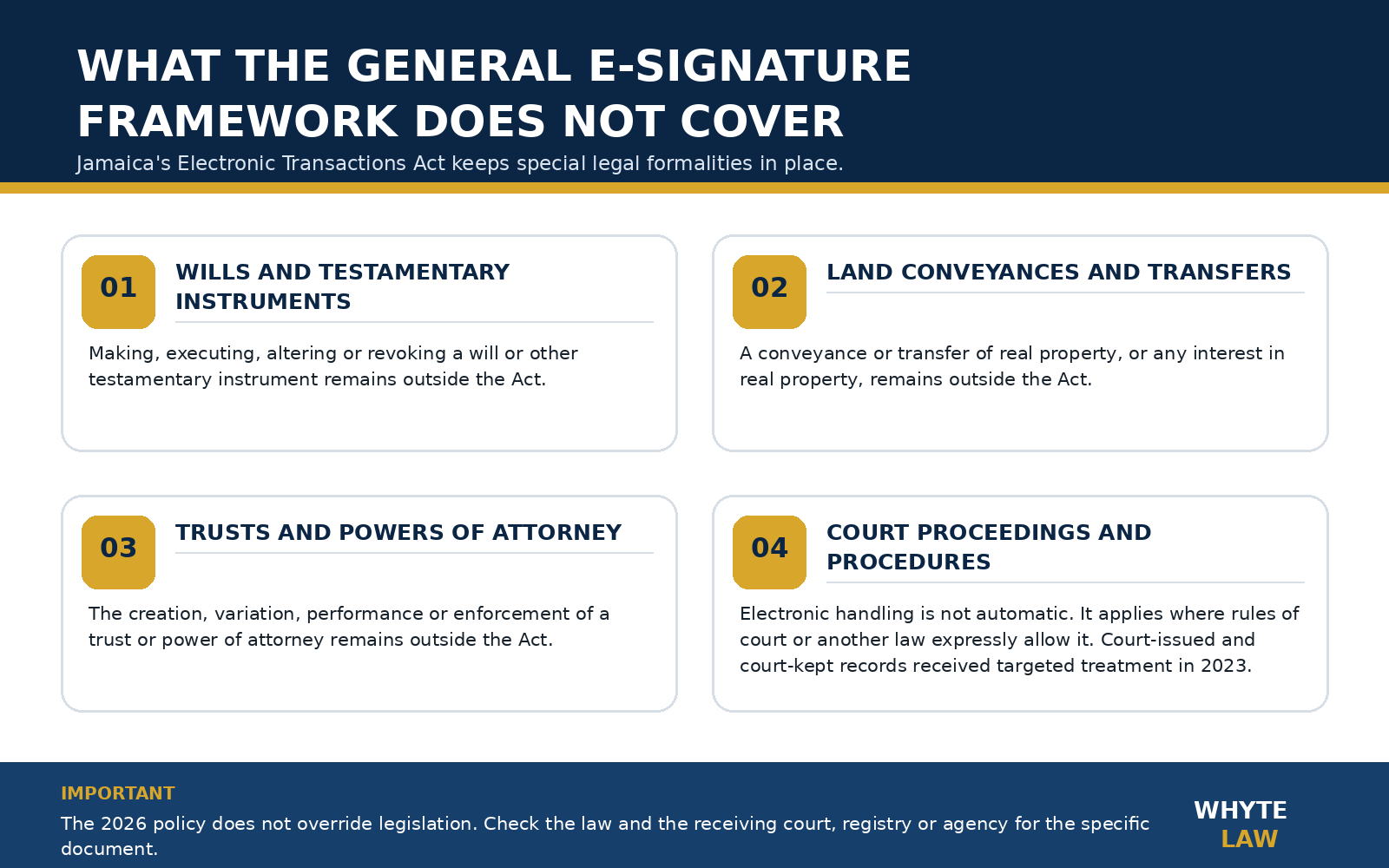
Infographic explaining the documents outside Jamaica's general electronic-signature framework

Jamaica begins September with two important changes to the way official business is done. Government agencies are moving to electronic signatures under a new Ministry of Finance policy. At the same time, financial institutions are beginning a phased withdrawal of Jamaican-dollar cheques, starting with cheques valued at J$1 million or more.

The changes point in the same direction, but they are not the same policy. One concerns how documents are signed and retained in the public sector. The other concerns how money moves through the banking system.

For the public, the practical message is simple: more transactions can now move electronically, but the law still decides which documents may be signed that way. A signature pasted into a PDF is not automatically suitable for every purpose. A payment sent electronically does not make the underlying legal instrument electronic.

What changed for government documents?

Circular No. 11, issued by the Ministry of Finance and the Public Service, directs entities within Jamaica's specified public sector to implement electronic signatures from 1 September 2026. Cabinet approved the policy through Decision No. 23/26.

The policy covers official government business, including internal approvals, correspondence, procurement recommendations, contracts, payment vouchers, invoices, human-resource actions and some regulatory or statutory instruments. It also directs public entities to accept electronic source documents used to facilitate the payment of public funds.

This is not an unrestricted permission to sign everything electronically. The policy is expressly subject to the Electronic Transactions Act and every other law governing the particular document or transaction. Where legislation still requires wet ink, the traditional requirement remains.

Where electronic execution is lawful and the chosen method provides the required level of assurance, a public entity should not demand wet ink merely because the record is electronic.

That is an important change in administrative culture. Paper is no longer supposed to be the default simply because it is familiar.

Not every electronic signature is equal

The phrase "electronic signature" covers more than one method. It may include a signing action within an authenticated government system, a digital signature protected by cryptography or an image of a handwritten signature inserted into a document.

Circular No. 11 adopts a risk-based model:

  • Low-risk transactions, such as routine internal acknowledgements and administrative memoranda, require a secure electronic signature with a record showing who signed and when.
  • Moderate-risk transactions, including human-resource approvals, procurement recommendations and financial authorisations, call for a digital signature supported by strong authentication, such as multi-factor authentication.
  • High-risk transactions, including contracts, statutory instruments and decisions carrying substantial financial or legal consequences, call for a certificate-based digital signature recognised under the statutory certification framework.

An image of a signature may be accepted for a low or moderate-risk transaction where the signer's identity can reasonably be established and the transaction does not create a high-risk obligation. The policy is clear that a person's signature image cannot be delegated for someone else to use.

The distinction matters. A visible signature shows that an image appears on a page. A secure digital process can also provide evidence of identity, intention, time of signing and whether the document changed afterwards.

Government agencies must decide what they will accept

Each public entity must formally classify its transaction types and maintain a register identifying those eligible for electronic signing. The register should record the transaction type, risk category, assurance level and permitted signature method.

This means implementation may not look identical across government. A simple application form may qualify for an image-based signature while a high-value contract may require a certificate-based signature and an auditable signing platform.

The receiving agency therefore remains important. Before relying on an electronic signature, a person should know whether the transaction is included in that agency's register and which form of signature the agency requires. That is not a licence for arbitrary refusal. Circular No. 11 warns that repeated refusal to recognise valid electronic signatures may amount to an internal-control or administrative-compliance failure.

Where the digital rule stops

The Electronic Transactions Act gives electronic records and signatures broad legal recognition. It also contains deliberate exclusions. Circular No. 11 cannot override them.

The principal exclusions concern wills and other testamentary instruments, conveyances and transfers of land, trusts and powers of attorney. Court proceedings require more careful treatment following a 2023 amendment: electronic processes may be used where rules of court or another law expressly permit them, while court-issued documents and records kept by a court received targeted statutory recognition.

The safer description is therefore not that every court document is barred from electronic use. It is that court proceedings do not enter the electronic regime automatically. The applicable rules and the receiving court's requirements must be checked for the particular process.

The same caution applies to documents requiring attestation, notarisation, verification or an oath. The Act contains a mechanism by which those requirements may be satisfied electronically, but the relevant law, the prescribed process and the receiving authority still control. A person should not assume that an ordinary pasted signature replaces witnessing, notarisation or swearing.

A useful example: the money may be digital while the land document is not

A property transaction demonstrates the dividing line.

From September, purchase money of J$1 million or more will ordinarily move by an electronic large-value payment method rather than a Jamaican-dollar cheque. Yet the Agreement for Sale, Transfer of Land, mortgage or other document that conveys or transfers an interest in land remains outside the Electronic Transactions Act's general framework.

The payment channel and the method of executing the legal instrument answer different questions. Sending the funds by electronic transfer does not remove the execution, witnessing, stamping or registration requirements governing the land document.

That distinction is especially important for Jamaicans living overseas. Digital payment and electronic communication may shorten the transaction, but documents intended for use in Jamaica must still satisfy Jamaican law and the requirements of the receiving registry, court or agency.

The second September change: J$1 million cheques are being phased out

The banking transition is separate from Circular No. 11, although it begins on the same date.

From 1 September 2026, Jamaican financial institutions will generally stop accepting or processing Jamaican-dollar cheques valued at J$1 million or more. The restriction includes a cheque for exactly J$1 million and includes personal, business and manager's cheques.

It does not mean that every cheque disappears immediately. Cheques below J$1 million may continue during the first phase, subject to the bank's normal rules. Foreign-currency cheques and cheques drawn on overseas banks are outside this first phase.

The published transition is:

  • 1 September 2026: cheques for J$1 million or more discontinued
  • 1 March 2027: threshold reduced to J$500,000
  • 1 September 2027: threshold reduced to J$100,000
  • 1 March 2028: Jamaican-dollar cheque processing ends

Some institutions may have narrow rules for an in-house cheque presented directly to the bank on which it is drawn. NCB, for example, has described such an exception for qualifying NCB house cheques. It should not be assumed that every bank will offer the same treatment. The issuing and receiving banks' current rules should be confirmed.

RTGS replaces the large cheque

For a large Jamaican-dollar payment between different banks, Real Time Gross Settlement, commonly called RTGS, is the principal alternative. The Bank of Jamaica describes JamClear RTGS as the system for large-value payments of J$1 million or more and for time-critical payments.

Unlike a cheque, which must be presented and cleared, an RTGS payment is settled individually through participating financial institutions. Banks may also offer internal account transfers, ACH credits and other approved business-payment services depending on the amount, timing and destination.

People should not divide one large obligation into several smaller cheques simply to avoid the threshold. Apart from defeating the purpose of the transition, this may conflict with a bank's policies or transaction-monitoring requirements.

Digital does not mean risk-free

The move away from paper reduces risks associated with lost, altered, duplicated or forged cheques. It introduces a different risk: money sent to the wrong account or to a fraudster using false payment instructions may be difficult to recover.

Changed banking instructions deserve particular caution. Account details received by email or messaging service should be verified through an independent and trusted channel before a high-value payment is authorised. The payer should retain the bank's confirmation, reference number and the verified payment instructions as part of the transaction record.

The same principle appears in the electronic-signature policy. A sound digital transaction is not merely paper reproduced on a screen. It must preserve identity, intention, integrity and an audit trail.

Personal guidance

Need help with your matter?

Book a consultation to discuss your situation and get clear guidance on next steps.

This is general information, not legal advice. Outcomes depend on the facts of each case.

Reader check-in

Was this guide helpful?

A quick check before you leave.

Chat on WhatsApp